Static Is the New Subversion: How VHS Decay Became 2024's Sharpest Creative Protest
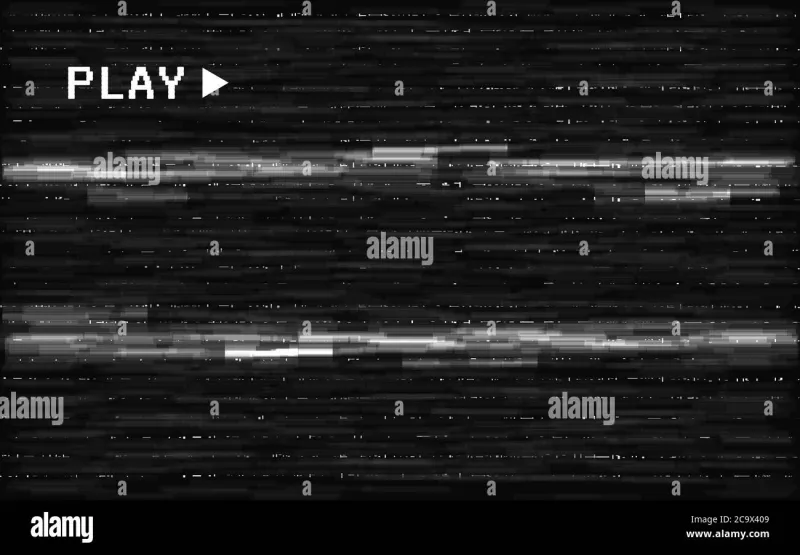
Photo: VHS tape distortion glitch analog static vintage camcorder artistic, via c8.alamy.com
There's something almost violent about the way a VHS tape degrades. The image doesn't just fade — it bleeds. Colors hemorrhage into each other. Horizontal lines tear across faces. The audio warbles like a drunk ghost trying to carry a tune. For most of the past two decades, that kind of visual corruption was something you'd apologize for. In 2024, it's something you'd build an entire artistic identity around.
And that shift? It's not an accident.
The Algorithm Wants You Smooth
If you've spent more than ten minutes scrolling through any major content platform lately, you've felt it — that eerie, frictionless sameness that coats everything. Skin tones corrected to impossible perfection. Cinematography so clean it feels like it was rendered rather than recorded. AI upscaling tools that strip the humanity out of older footage and replace it with something that technically looks "better" but somehow feels less.
Mainstream music videos, brand content, and even indie releases are increasingly pressured to hit a certain visual standard — one that's less about artistry and more about surviving the recommendation engine. Platforms reward content that retains viewers, and retention algorithms have developed a quiet preference for visual clarity, fast cuts, and high production value. The result is a kind of aesthetic monoculture that's as creatively deadening as it is commercially logical.
Which is exactly why a growing number of creators are doing the opposite — on purpose.
Tape as Testimony
Meet the artists who are digging VHS cameras out of thrift stores, running footage through actual magnetic tape, and deliberately introducing the kind of degradation that would make a YouTube algorithm wince. They're not doing it because they can't afford better gear. They're doing it because "better" is exactly what they're arguing against.
Los Angeles-based director and visual artist Mara Solís has been shooting music videos on consumer-grade VHS camcorders since 2022, but says 2024 felt like a turning point in terms of how audiences are receiving that work. "People used to ask me why I was using old equipment like it was a limitation," she explains. "Now they ask me why I'm using it like they already understand there's a reason. The conversation changed."
For Solís, the warped chromatic edges and rolling static lines aren't decorative flourishes — they're statements about authenticity in an era when authenticity itself has been industrialized. "AI can generate a face that looks more human than a human," she says. "But it cannot generate a tape dropout at exactly the wrong moment that somehow makes a lyric hit harder. That's still ours."
Nostalgia Isn't the Point — Resistance Is
It would be easy — and lazy — to write off the VHS revival as pure nostalgia. And sure, there's a generational memory component for older millennials who grew up rewinding rental tapes. But the artists most aggressively pushing this aesthetic in 2024 aren't necessarily the ones who lived through the VHS era. A significant chunk of them are Gen Z creators who've never owned a physical tape in their lives.
For them, VHS isn't about remembering — it's about refusing.
New York-based video artist and musician Dex Calloway, 24, puts it bluntly: "I didn't grow up with VHS. I grew up with YouTube. And YouTube taught me that everything needs to be 4K and color-graded and perfect or nobody will watch it. So when I started shooting on tape, it felt like breaking a rule that nobody had written down but everyone was following."
Calloway's recent visual project — a series of short-form music videos shot entirely on a 1989 JVC camcorder and distributed through underground video channels rather than mainstream platforms — drew attention precisely because of how aggressively imperfect it looked. "People kept telling me it looked 'damaged,'" he says, laughing. "I was like — yeah. That's the whole thing."
The Philosophy Behind the Static
There's a deeper intellectual current running through all of this. When an artist chooses magnetic tape artifacts over digital clarity, they're implicitly making an argument about what visual media is for. Polished content, the thinking goes, is designed to be consumed efficiently and forgotten quickly — optimized for the scroll, not for the soul. Degraded, imperfect, analog-inflected imagery demands something different from the viewer. It slows you down. It makes you work a little. It refuses to be invisible.
There's also something philosophically honest about embracing decay. Tape deteriorates. It records the passage of time in a way that digital files simply don't — a digital copy from 2001 looks identical to one made yesterday, but a VHS tape from 2001 shows you those twenty-three years in every warped frame. For artists grappling with questions of memory, mortality, and cultural impermanence, that physical honesty carries real weight.
Chicago-based experimental filmmaker Rae Whitmore, whose work has been screened at several independent art festivals across the Midwest, describes the appeal in almost spiritual terms. "Digital preservation is a lie we tell ourselves," she says. "It promises permanence but delivers nothing with texture. Tape admits it's going to fall apart. I find that more truthful than anything a render farm can produce."
When Imperfection Becomes Infrastructure
What's particularly interesting about the VHS aesthetic movement in 2024 is how it's built its own distribution infrastructure to match its production philosophy. Many of the artists leading this charge are deliberately avoiding the major platforms — or at minimum, treating them as secondary. Zines, physical tape distribution, underground screening events, and niche video platforms that don't punish unconventional content are increasingly part of the ecosystem.
It's a full-stack rejection of the mainstream pipeline, from how the content is made to how it reaches an audience. And that coherence — the way the medium, the message, and the distribution all line up — is part of what gives the movement its credibility.
The Acid Rain Take
Here at Acid Rain Video, we've always believed that the most interesting visual work happens at the edges — where the rules break down and something real starts to bleed through. The VHS aesthetic movement in 2024 isn't just a trend or a throwback. It's a coherent philosophical position disguised as a production choice.
In a world where AI can generate infinite hours of visually flawless content on command, the artists reaching for warped tape and magnetic noise are making a claim that feels almost radical: that imperfection is irreplaceable. That the human hand — or in this case, the degrading machine — leaves a mark that no algorithm can fake.
Static, it turns out, has something to say. And right now, it's saying it louder than anything running at 4K.