No Screen Required: The Filmmakers Projecting Video Onto Bodies, Fog, and Everything Else
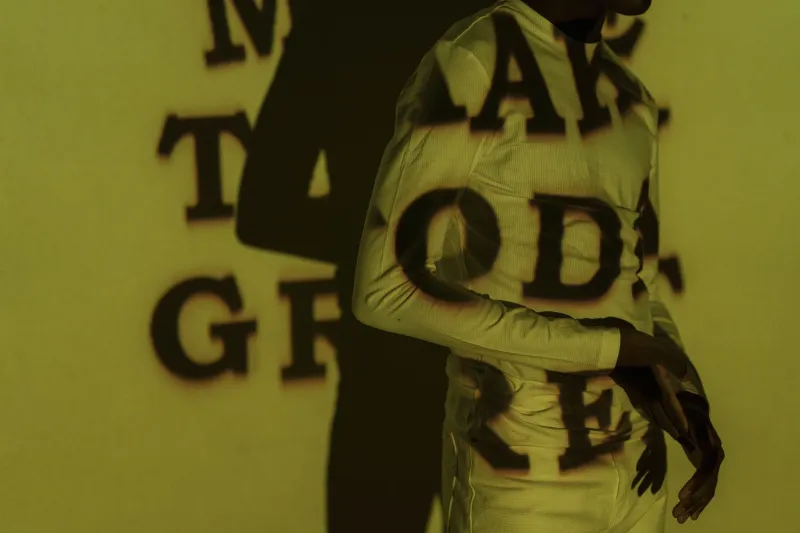
There's a warehouse in East Austin where, on the last Friday of every month, a filmmaker named Dez Holloway projects video onto the bodies of volunteer performers. Not onto a screen behind them. Onto them — skin, fabric, hair, the specific geography of a human being standing still in a dark room. The images move. The people breathe. The projection shifts with every inhale. Nothing is recorded. When the projector cuts, the work ceases to exist.
This is where experimental video is going, and it has nothing to do with resolution.
Abandoning the Rectangle
The flat rectangular screen has been the assumed delivery format for moving images since pretty much forever. Film projectors threw light at flat white surfaces. Television put a glowing rectangle in your living room. Computers shrank the rectangle and put it in your pocket. Every iteration of video technology, for over a century, has been organized around the assumption that images live on flat, stable, capturable surfaces.
A growing number of experimental video artists are done with that assumption entirely.
The work being made in this space — sometimes called expanded cinema, sometimes projection performance, sometimes just called what it is — uses video as light rather than as content. The projector becomes a tool for painting with moving images onto whatever surface the artist chooses: water in a shallow basin, a hanging curtain of theatrical fog, the curved surface of a human torso, a pile of crumpled aluminum foil, a wall of hanging thread. The surface isn't incidental. The surface is the medium.
"A screen is a promise," says Portland-based artist Rhea Solano, whose recent work projects looping video onto large water tanks positioned in gallery spaces. "It promises you a stable image, something you can look at and then look away from and it'll still be there. I'm interested in what happens when you break that promise. When the image is genuinely there one second and different the next."
What Happens When Light Hits Water
Solano's water projections are worth spending some time with because they illustrate exactly what makes non-screen surfaces so generative. When video is projected onto still water, you get a relatively coherent image — distorted at the edges, rippled by air currents, but recognizable. Introduce any movement and the image fractures. The pixels scatter. Color separates. A face becomes an abstract field of light patches.
Now project onto water that's being gently agitated from below, and you have an image that's in constant, unpredictable transformation. The video content — whatever Solano is projecting — becomes a raw material that the water processes in real time. The same file plays every night. The image is never the same twice.
This is the quality that draws artists to non-screen surfaces: they introduce a collaborating force that no editing software can simulate. The fog machine has its own logic. The human body breathes, shifts weight, responds to temperature. The water moves according to fluid dynamics. The video artist provides the light; the surface provides everything else.
The Body as Screen
Body projection — video cast directly onto human performers — has been around in various forms since the 1960s, but the current generation of artists working in this mode is doing something that feels distinct from the theatrical spectacle of earlier approaches.
Dez Holloway's monthly Austin events are deliberately intimate. Twenty, maybe thirty people in a room. A single performer. A single projector. The video content tends toward abstraction — light fields, color progressions, occasionally text. The point isn't to turn a person into a canvas for representational imagery. It's to explore what happens when moving light encounters the specific, irreducibly individual surface of a particular human body.
"Every person I work with changes the work completely," Holloway explains. "The same projection on two different people is two completely different pieces. The collarbones catch light differently. The way someone holds their head changes where shadows fall. The body is doing interpretive work whether it means to or not."
There's an ethical dimension here that Holloway is deliberate about navigating. The performers are collaborators, not props. They make choices about how they move, how they position themselves, how much they engage with the light falling on them. The work is genuinely collaborative in ways that projection onto inanimate surfaces simply isn't.
Why Impermanence Is the Point
The question that comes up constantly when people encounter this work is some version of: but how do you document it? How do you share it? How does anyone who wasn't in the room ever experience it?
The artists making this work have a consistent answer: they don't. That's not a problem to be solved. It's a position.
In a cultural moment defined by the assumption that everything can and should be captured, distributed, and accessed indefinitely, making work that exists only in a specific room at a specific time is a radical act. It's a refusal of the logic that says value equals reach, that art is only real if it can be streamed.
Rhea Solano puts it plainly: "If I document the water projection, I get a video of a projection onto water. That's not the work. The work is being in the room with the water and the light and whatever's happening between them. The documentation is a lie about what the thing is."
This position has real consequences for how these artists navigate the contemporary art world, which still largely runs on documentation, portfolios, and digital distribution. Most of them accept the tension rather than resolving it. They show up, make the thing, let it end, and move on.
Finding the Work
If you want to see this stuff, you have to actually go somewhere. Experimental film festivals are the most reliable entry point — events like Antimatter in Victoria, BC, or the Ann Arbor Film Festival in Michigan frequently feature projection performance work. DIY spaces, warehouse venues, and alternative galleries in most major US cities host occasional events, usually promoted through mailing lists and word of mouth rather than algorithmic feeds.
That friction is, again, not incidental. The audience for work that refuses documentation tends to be an audience that's willing to show up, be present, and accept that what they experience won't be available for later review.
In a weird way, that's the most demanding thing experimental video is asking of people right now. Not to watch something. To actually be somewhere.
The screen has been replaced by the room. The room is the whole point.