Scratched, Dusty, and Defiantly Human: Why Film Grain Is the New War Paint
Something interesting happens when you show a 22-year-old filmmaker a perfectly rendered, AI-generated video. They don't go wide-eyed with envy. A lot of them flinch.
It's not jealousy. It's recognition — the same way you'd recognize a deepfake two seconds before your brain catches up. The image is technically flawless, and that's exactly the problem. There's no fingerprint on it. No proof that anyone bled for it, stayed up too late for it, or burned through their last roll of Kodak Vision3 for it. It looks like it came from nowhere, because it kind of did.
And right now, in 2024, that's the most damning thing you can say about a piece of visual work.
The Machine Has Incredible Taste (And Zero Soul)
Let's be honest about what AI image and video generation actually does well. It synthesizes. It pattern-matches across billions of human-made images and produces something that statistically resembles what people tend to find beautiful, dramatic, or cinematic. It's basically the world's most sophisticated average.
That's also its ceiling.
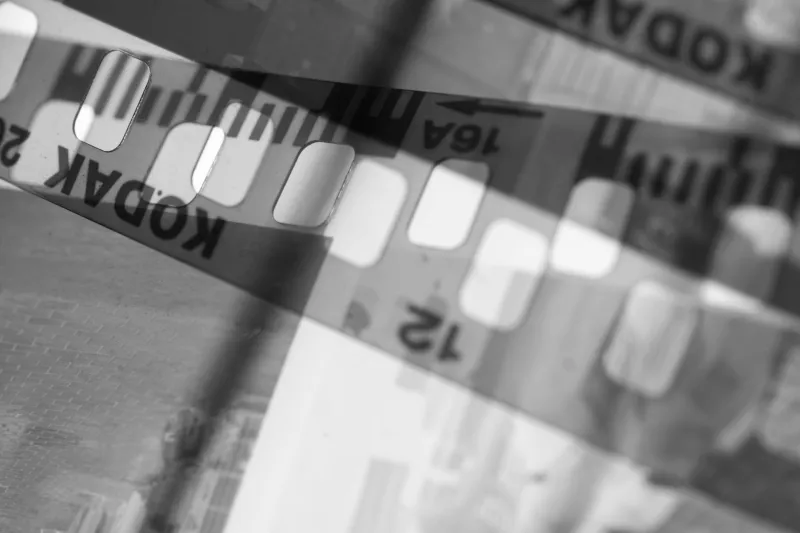
What machine learning can't replicate — at least not yet, and maybe not ever in a way that matters — is the chain of physical decisions that produces a real piece of film. The choice to load a specific stock. The way afternoon light behaves differently through a scratched-up prime lens you bought off eBay for $40. The color shift that happens when your developing tank runs slightly too warm. These aren't just aesthetic quirks. They're a record of choices, circumstances, and accidents made by an actual person in an actual moment.
Film grain, in this context, isn't noise. It's evidence.
Why Gen Z Is Going Backward to Go Forward
There's a narrative that gets applied lazily to younger creators gravitating toward analog — the nostalgia angle, the vintage aesthetic play, the Instagram filter logic. That framing misses the point almost entirely.
Talk to the filmmakers actually doing this work and the conversation sounds less like nostalgia and more like resistance strategy. Creators in their early twenties who grew up entirely inside digital culture aren't reaching for film because it reminds them of something. Most of them have no personal memory of it being the default. They're reaching for it because it does something that no other medium can do right now: it proves the work is real.
In an environment where a prompt can generate a cinematic-looking short film in under ten minutes, authenticity has become the scarcest resource in visual culture. Physical media creates what you might call an unfakeable provenance — a paper trail of human decisions baked into the material itself. You can simulate grain in post. You cannot simulate the actual silver halide crystals that caught actual photons bouncing off an actual face in an actual room. The difference is subtle, and it's also everything.
The Imperfection Industrial Complex
Here's where it gets interesting from a craft standpoint. The creators leading this charge aren't just shooting on film and calling it a day. They're actively engineering imperfection — pushing expired stock, cross-processing, deliberately underexposing, letting dust settle on the gate. The goal isn't a clean vintage look. The goal is maximum evidence of physical reality.
Directors like Mia Engberg, Leilah Weinraub, and a newer generation of no-budget music video makers working out of cities like Detroit, New Orleans, and Portland have been exploring this territory in different ways, but the through-line is consistent: the artifact is the argument. Every scratch in the emulsion is a timestamp. Every color cast is a material signature.
This is a fundamentally different relationship with imperfection than what previous generations of indie filmmakers had. For a long time, lo-fi aesthetics were framed as a workaround — you couldn't afford to look polished, so you reframed the limitation as a style. What's happening now is something more aggressive. These creators have access to digital tools that can produce technically pristine work. They're choosing not to use them, or they're using them to simulate analog in ways that are then layered on top of actual analog to create something genuinely strange and hybrid.
The imperfection isn't a consolation prize. It's the whole point.
Authenticity as a Political Act
It would be too easy to frame this purely as an aesthetic conversation. The choice to shoot on physical media right now is also a statement about labor, authorship, and the economics of creative work.
When an AI system generates a visual, it does so by training on work made by human artists — often without compensation or consent. The output looks like art but is structurally a redistribution of existing human creative labor into a product that competes with the people whose work it consumed. A lot of young creators are acutely aware of this dynamic, and their turn toward film is partly a refusal to participate in that loop.
Shooting on film costs money, takes time, demands skill, and produces something that cannot be reverse-engineered into a training dataset in any meaningful way. It is, by its nature, a closed system. The work exists as a physical object before it exists as data. That distinction feels increasingly important in a moment when the boundary between human-made and machine-generated content is being erased in real time.
What This Looks Like in Practice
The visual results of this movement are striking precisely because they resist easy categorization. A music video shot on Super 8 with deliberate light leaks and processed at a non-standard temperature doesn't look like a vintage throwback — it looks like something that couldn't have been made any other way, by anyone other than the person who made it. The specificity is the point.
This kind of work is also starting to shape what audiences expect from credible visual art. There's a growing literacy around the difference between simulated grain and real grain, between a digital color grade imitating analog warmth and the actual chemical process producing it. Viewers who've been trained on algorithmically optimized content are increasingly sensitive to the presence — or absence — of that human fingerprint.
The Grain Is the Message
Film grain has always been a byproduct of how photographic emulsion works. It was never supposed to be the statement. But context changes everything, and right now, in a visual landscape increasingly populated by content that was never touched by human hands, that grain carries weight it's never carried before.
It says: someone was here. Someone made a decision, loaded a camera, stood in a room, pointed the lens, and pressed the shutter. Something physical happened. And the proof is in every imperfect, irregular, beautifully chaotic silver crystal scattered across the frame.
In the age of the algorithm, that might be the most radical thing a visual artist can put on screen.