No Budget, No Problem: 5 Underground Directors Who Are Rewriting the Music Video Playbook
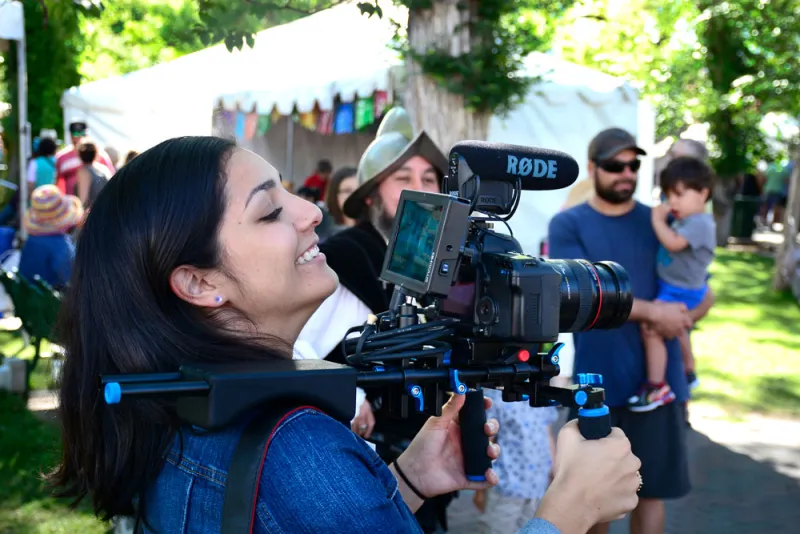
Photo: indie filmmaker guerrilla filmmaking urban street video production, via cdn.mos.cms.futurecdn.net
The major label music video machine is impressive in the way that a very expensive sports car is impressive: polished, powerful, and ultimately kind of boring once you've seen enough of them. The real action — the stuff that actually moves people, that gets screenshotted and shared and argued about at 2am — is coming from somewhere else entirely.
It's coming from directors who shoot on weekends, borrow their cousin's camera, and figure out how to make a parking structure in Burbank look like another dimension. These are their stories.
1. Janelle Okafor — Turning Chicago's South Side Into a Cinematic Universe
Janelle Okafor didn't go to film school. She went to YouTube — obsessively, methodically, watching every behind-the-scenes breakdown she could find until she understood the language well enough to start inventing her own dialect.
Her breakthrough came with a video for Chicago rapper Milo Vega that she shot over three weekends with a borrowed Sony ZV-E10 and a reflector she made from a piece of foam board wrapped in emergency blanket material. The concept was deceptively simple: Vega performing on rooftops and loading docks across the South Side, the city unfolding behind him like a character in its own right.
What made it work: Okafor shoots almost exclusively during the golden hour — not because it's trendy, but because it's free. Natural light during those 45 minutes before sunset does things that a $10,000 lighting rig can only approximate. She also leans into the environment rather than fighting it. "I'm not trying to make the South Side look like somewhere else," she's said in interviews. "I'm trying to make it look like exactly what it is, which is already cinematic as hell."
The video racked up nearly 400,000 views on YouTube within two months. No PR campaign. No label push. Just word of mouth from people who recognized something real.
Her toolkit: Sony ZV-E10, DaVinci Resolve for color grading, a reflector she made herself, and an encyclopedic knowledge of her neighborhood's light patterns.
2. Marco Delgado — The King of Practical Effects on Zero Dollars
Marco Delgado's videos look like they cost a quarter million dollars. They cost, on average, about $800. The gap between those two numbers is filled entirely with ingenuity and an almost alarming willingness to experiment.
Based in East LA, Delgado has built a reputation for practical effects work that would make old-school Hollywood production designers jealous. He's created underwater sequences in a backyard kiddie pool with a waterproofed GoPro. He's built miniature cityscapes out of cardboard and shot them with forced perspective to make them look full-scale. He rigged a camera to a ceiling fan to create a rotating overhead shot that looks like it came from a drone.
What made it work: Delgado is obsessed with the question: "What would this look like if I just tried it?" He keeps a running document of effects he wants to attempt — some practical, some digital, some that exist in a weird hybrid space — and every new project becomes an opportunity to cross something off the list. His trial-and-error process is extensive and messy, but the results are consistently surprising.
His video for indie synth artist Paloma Reyes, which featured a sequence where the artist appears to walk on the ceiling of her apartment (achieved with a completely rebuilt room set and some careful editing), went viral in the synth-pop community and landed Delgado his first paid commission from an independent label.
His toolkit: GoPro Hero 12, a Canon R50, cardboard, mirrors, string lights, and an absolute refusal to accept that something is impossible until he's actually tried it.
3. Destiny Wren — Narrative Storytelling in Under Four Minutes
Most music videos treat narrative as decoration. Destiny Wren treats it like the whole point.
The Atlanta-based director approaches every video like a short film with a soundtrack, developing character arcs and visual motifs that give even a three-minute clip the emotional weight of something much longer. Her video for R&B artist Kezia Bloom — shot over a single day in a rented Airbnb and a nearby park — told a complete story of a relationship's beginning and end using only visual cues, no dialogue, no text overlays.
What made it work: Wren does extensive pre-production for projects that most directors would treat as quick shoots. She storyboards everything, scouts locations obsessively, and writes character backstories for the people in her videos even when those people are just the performing artist. That level of preparation means she can move fast on the day, capturing everything she needs without wasted time or takes.
She also has an instinct for casting non-professional actors from her community and directing them toward naturalistic performances that feel genuinely unposed — a skill that's genuinely rare and genuinely hard to fake.
Her toolkit: iPhone 15 Pro (seriously — she's evangelical about its cinematic capabilities), Final Cut Pro, and a pre-production process that would put some film school graduates to shame.
4. Theo Park — Guerrilla Shooting as Artistic Statement
Theo Park doesn't ask for permission. He asks for forgiveness, occasionally, but mostly he's already packed up and left by the time anyone official shows up.
The Brooklyn-based director has built an entire aesthetic around guerrilla filmmaking — shooting in public spaces, on transit, in stores, at events — without permits, without advance notice, and with a crew that usually consists of himself and one other person. The resulting videos have a kinetic, documentary energy that's impossible to manufacture in a controlled environment.
What made it work: Park understands that the anxiety of guerrilla shooting — the awareness that you might get kicked out at any moment, that you're operating in real, uncontrolled space — translates directly to the camera. His performers can't settle into the comfortable performance-mode that a closed set encourages. They have to be present, reactive, alive. The authenticity isn't performed. It's produced by circumstance.
His video for punk artist Sasha Crow, shot entirely on the New York City subway system over three late-night sessions, captures something about urban alienation and underground community that a studio set simply couldn't replicate. It has over 600,000 views and has been cited by several music critics as one of the best videos of 2023.
His toolkit: A Blackmagic Pocket Cinema Camera 6K, fast primes that work in low light, and a complete comfort with chaos.
5. Imani Ross — Using Community as Production Design
Imani Ross's videos feel like dispatches from a world you want to live in — warm, communal, overflowing with personality and texture. That's not an accident. It's the result of a deeply intentional approach to involving her community in every aspect of production.
Based in New Orleans, Ross treats her neighborhood as both location and collaborator. She casts local artists, musicians, and community figures in supporting roles. She shoots in spaces that matter to people — barbershops, second-line routes, backyard gatherings — and the people who belong to those spaces show up in the frame with a comfort and ownership that hired extras could never bring.
What made it work: Ross's videos cost almost nothing because the community provides almost everything. Locations are donated. People show up because they want to be part of something. The production design is the actual stuff of people's actual lives, which means it's richer and more specific than anything a set decorator could source.
Her recent video for jazz-adjacent artist Desi Fontenot — shot across a single Sunday in the Tremé neighborhood — has been described as feeling like a love letter to New Orleans, and not in the tourist-brochure way. In the way that only someone who actually loves a place can communicate.
Her toolkit: A Sony FX3, community relationships built over years, and an understanding that the best production design in the world is the one that already exists.
The Takeaway
These five directors share exactly one thing: they refused to wait for someone to give them permission or a budget to start making work. The rest of their approaches are wildly different — different cities, different tools, different aesthetics, different philosophies about what a music video is even supposed to do.
That diversity is the point. The underground music video scene right now isn't unified by a single look or a single method. It's unified by an attitude — the conviction that the work matters more than the resources, and that constraint, handled right, produces something that comfort and money never could.
The major labels will eventually notice these directors. Some of them will take those calls. Some won't. Either way, the work they're making right now, on their own terms, is the most interesting thing happening in visual music culture. And you can find it if you know where to look.